
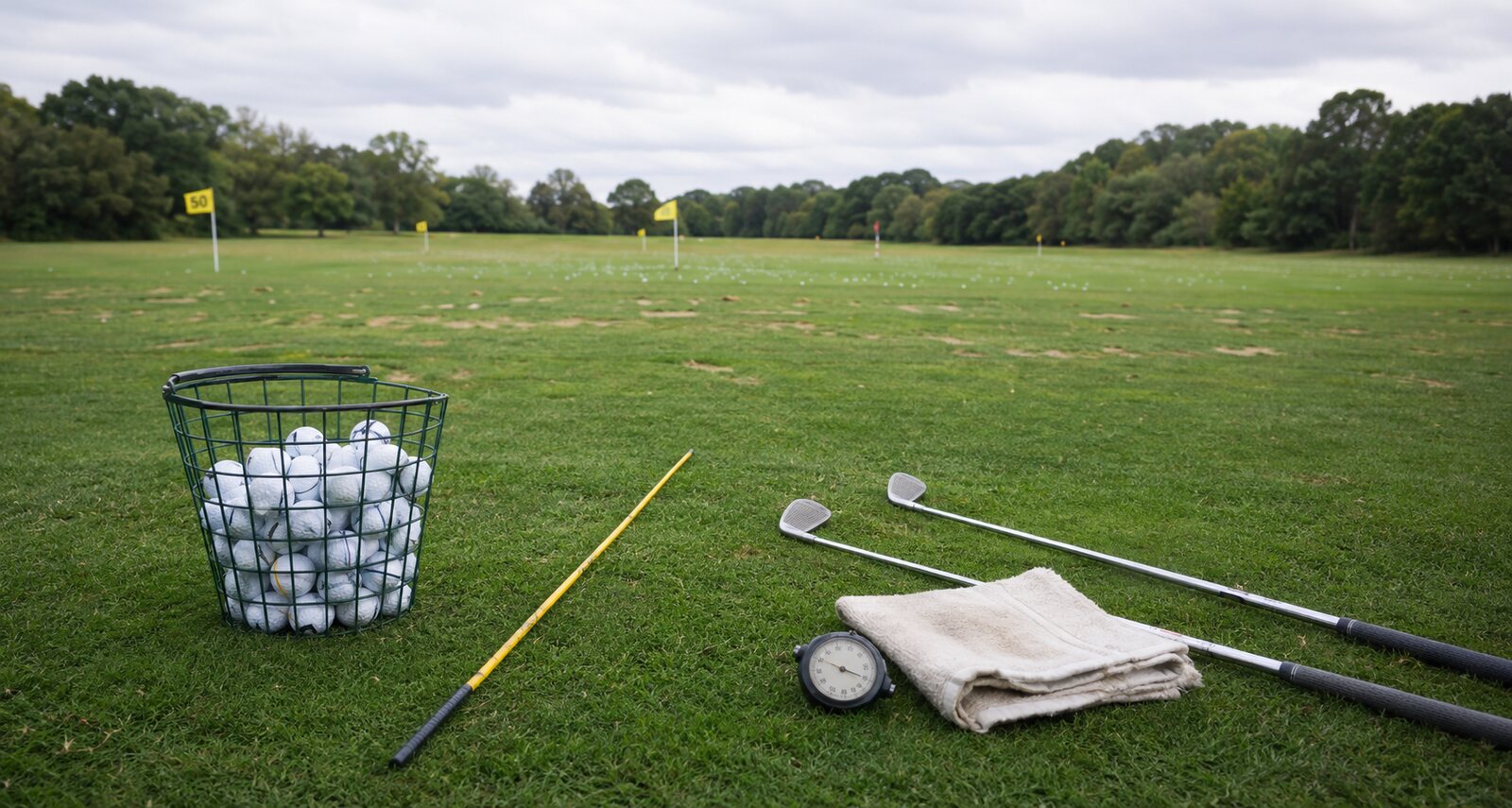
Direct answer: A useful one-hour range session is not a race to empty the bucket. It should produce a playable tee ball, address the stroke leak your scorecards identify, and finish with decisions that feel more like the course.
- Choose one process goal and three visible targets before the first ball.
- Score outcomes as playable, trouble, or penalty-likely—not good swing or bad swing.
- Change clubs and targets during the final block instead of repeating the same comfortable shot.
The plan at a glance
| Block | Minutes | Purpose | Score |
|---|---|---|---|
| Warmup | 0–10 | Easy contact and target focus | No swing score |
| Playable tee ball | 10–25 | Leave a normal next shot | Playable / trouble / penalty-likely |
| Highest leak | 25–40 | Work from round evidence | Metric matched to leak |
| Simulated holes | 40–55 | Transfer decisions | Manageable / compounded |
| Review | 55–60 | Choose the next action | One repeat + one adjustment |
Before you buy the bucket
Pick one outcome you can observe, such as starting the ball on your intended line or finishing inside a fairway-width window. Then identify a left, center, and right target. PGA guidance also emphasizes choosing targets, changing them, and practicing with a purpose rather than simply hitting balls.
Use the club you would actually choose on a narrow hole. If driver creates mostly penalty-likely outcomes today, the session does not improve by pretending every next ball is a fresh long-drive contest.
Minutes 0–25: warm up, then build a playable tee ball
Start with easy shots and a short club, increasing effort only as you feel ready. The first ten minutes are preparation, not a technical examination. From minutes 10–25, hit to different fairway-width targets and record each result.
A playable ball leaves an ordinary next shot. Trouble means a punch-out or severely restricted next shot. Penalty-likely means the ball would probably be lost, out of bounds, or in a penalty area on the course. Ten honest results are more useful than one perfect drive.
Minutes 25–40: work on the leak that costs you most
Use your three-round audit. If penalties lead, work on target and dispersion. If recoveries lead, rehearse choosing a safe exit target where the facility allows. If extra chips or three-putts lead, move to the short-game or putting area instead of forcing range balls to solve the wrong problem.
Keep the task measurable: balls inside a target window, first chips finishing on the green, or putts stopping in a finish zone. A lesson from a qualified coach is the better next step when contact or ball flight is unpredictable and you cannot identify why.
Minutes 40–60: simulate holes and write the next step
Play several fictional holes. Name the hole shape, select a club and target, hit one ball, and react to the result. A trouble result requires a conservative recovery; a playable result earns the next club. Do not replay a shot until it becomes perfect.
Finish with a recorded test of five or ten balls. Write one sentence: what should stay in the next session, and what should change? For 45 minutes, shorten each middle block by five minutes. For 30 minutes, use five minutes of warmup, ten minutes of playable tee balls, ten minutes on the highest leak, and five minutes for the test.
This article contains affiliate links. If you buy through them, Par Possible may earn a commission at no extra cost to you. As an Amazon Associate I earn from qualifying purchases. Full disclosure.
The only range aid most beginners need
You can run this entire session with two old clubs laid safely on the ground. If you want something lighter and easier to carry, the GoSports Golf Alignment Training Sticks can mark the target line, foot line, ball position, or a start-line gate. Do not place a rigid stick where the club could strike it.
Your next step
Download the free Break 100 Practice Checklist to identify the priority. When you want four weeks already scheduled, use the 4-Week Break 100 Practice Plan.
Related: How to Break 100 in Golf and the five-stroke-leak audit.