
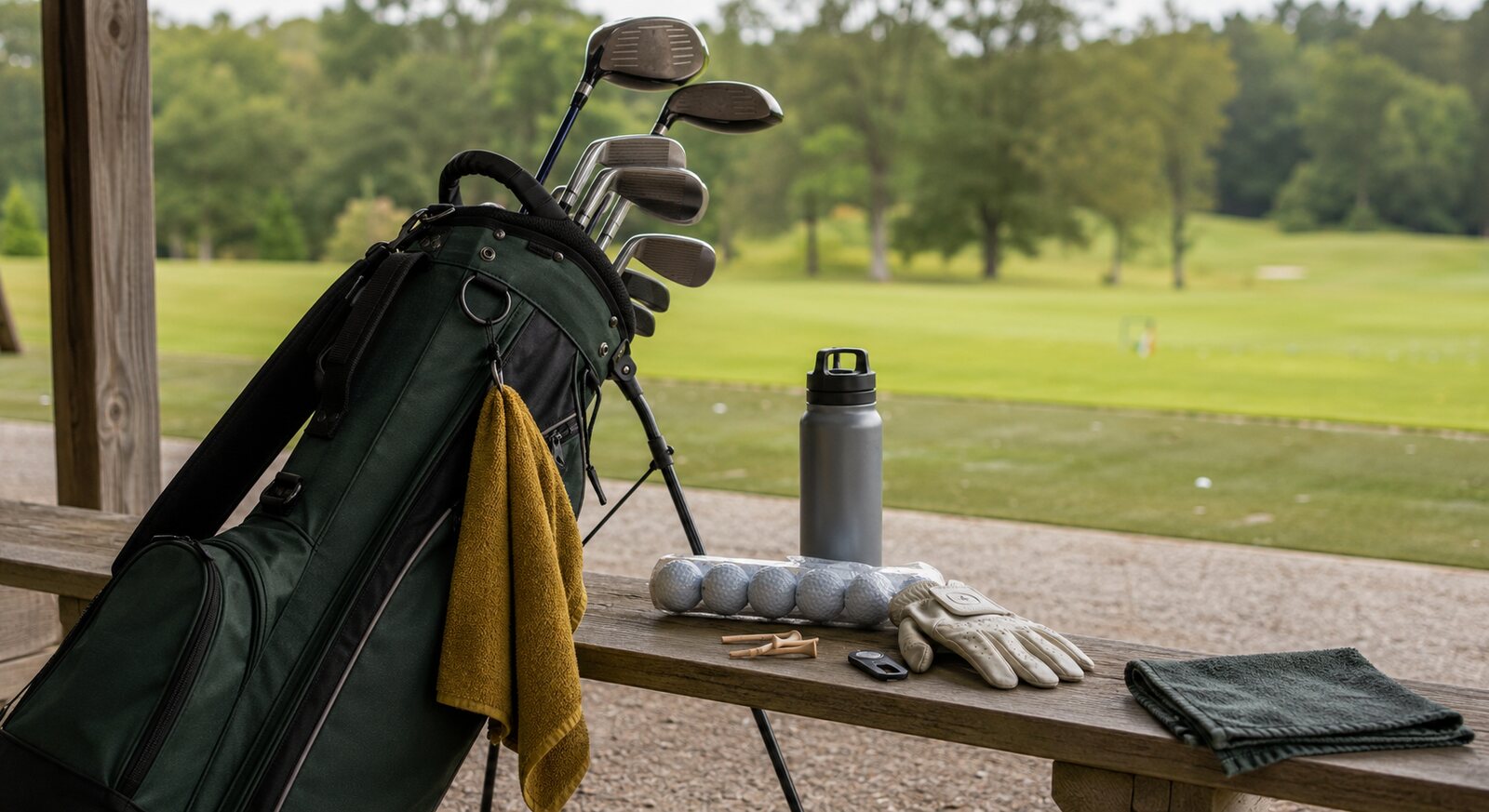
Direct answer: A beginner needs enough equipment to play safely, comfortably, and without delaying the group—not a full premium bag. Start with a playable set, bag, affordable balls, tees, a marker, and weather-appropriate basics.
- Must-have: playable clubs, bag, balls, tees, marker/divot tool, suitable footwear, and weather basics.
- Useful soon: glove, towel, rain gear, rangefinder, push cart, or practice aid when it solves a problem you already have.
- Skip for now: premium upgrades without a clear comfort, access, or scoring reason.
The plan at a glance
| Tier | Decision rule |
|---|---|
| Must-have | Needed to play safely, meet course expectations, or complete ordinary shots |
| Useful soon | Solves a problem the beginner is already experiencing |
| Skip for now | Adds cost without a demonstrated benefit |
A practical first bag
You may carry fewer than 14 clubs. The USGA confirms that 14 is the maximum, not a requirement. A practical starter setup can include a tee club, several clubs that cover useful distance gaps, a wedge or other short-game option, and a putter.
Exact loft, length, flex, and set makeup depend on the golfer. Used clubs can reduce cost, but inspect condition and confirm that the set is suitable before buying.
The small items that matter
Buy balls you can afford to lose and enough tees for the round. Carry a ball marker and divot-repair tool, and learn the course’s repair expectations. Comfortable footwear matters; shoe and dress requirements vary by facility.
Add sun, rain, cold-weather, hydration, and personal medical needs according to conditions. These are more useful than an accessory bought only because it appears in every golf-bag video.
Useful later
A glove can improve comfort for some players. A towel, rain gear, push cart, or rangefinder may solve real friction. A practice aid is useful when it measures a specific task that cannot be set up more simply.
Do not buy a new driver solely because of a launch claim, multiple specialty wedges without a use case, or premium balls before you know what problem the purchase should solve.
A buying checklist
Name the job, set the budget, compare used and new options, inspect condition, check the return policy, and avoid assuming that a higher price is a better fit.
This article contains no affiliate product links. Future commercial recommendations will be disclosed near the link and labeled by evidence level.
Sources and scope
Official rule reference: USGA — Clubs.
Your next step
Download the free Break 100 Practice Checklist to identify the priority. When you want four weeks already scheduled, use the 4-Week Break 100 Practice Plan.
Related: How to Break 100 in Golf and the five-stroke-leak audit.